
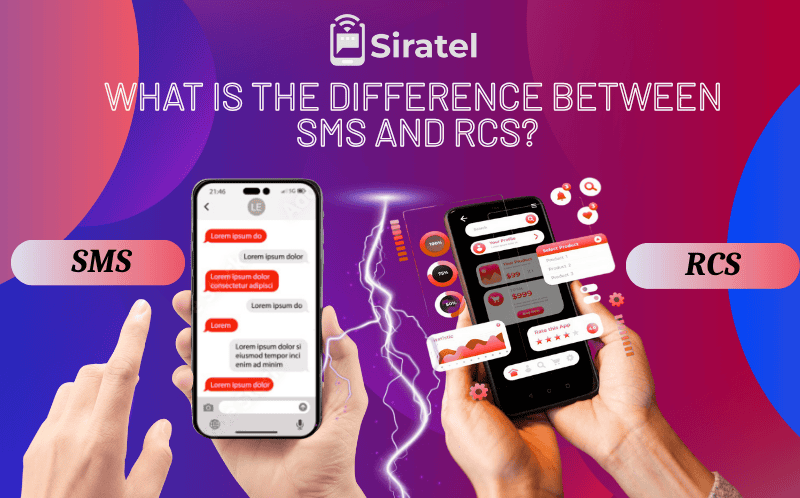
We all use text messages every day. But have you ever noticed how some messages look super plain, while others have buttons, pictures, and even your brand’s logo?
That’s the difference between SMS and RCS.
If you’re a business owner or marketer trying to reach customers, understanding this difference can change how people see and respond to your messages.
Let’s break it down in simple words.
What Is SMS?
SMS stands for Short Message Service. It’s the most basic form of mobile messaging — plain text only, no internet needed.
Example:
“Your OTP is 123456.”
“Your order has been shipped.”
That’s a classic SMS. It’s simple, fast, and works on every phone.
Key Features of SMS
Works without the internet
Text only (no images, videos, or buttons)
Maximum 160 characters
Delivered instantly
Works on all phones, old or new
Quick Data:
SMS was first used in 1992
Over 5 billion users worldwide still use it
Average open rate: 98%
Response rate: around 6–8% only
In short: SMS is reliable, but very limited.
What Is RCS Messaging?
RCS stands for Rich Communication Services. Think of it as an upgraded version of SMS — like going from black-and-white TV to full HD.
RCS lets you send images, GIFs, videos, buttons, QR codes, and even live chat — all within the phone’s default messaging app.
Example: A flight message that includes your boarding pass image, check-in button, and real-time updates — that’s RCS.
Key Features of RCS
Works with the internet (Wi-Fi or mobile data)
Supports images, videos, and buttons
Shows when the message is read
Lets you see when someone is typing
Offers brand verification (so customers trust the message)
Allows two-way communication
Quick Data:
RCS is supported on 1 billion+ Android devices
Backed by Google and major telecom companies
Businesses using RCS see 30–40% higher engagement than SMS
What Is the Difference Between RCS and SMS?
The main difference between RCS and SMS is that SMS supports only plain text up to 160 characters, while RCS supports rich media like images, videos, and interactive buttons using the internet.
Let’s see this difference in detail.
RCS vs SMS Comparison Table
| Feature | SMS | RCS |
|---|---|---|
| Full Form | Short Message Service | Rich Communication Services |
| Launch Year | 1992 | 2007 |
| Internet Required | ❌ No | ✅ Yes |
| Media Support | ❌ Text only | ✅ Images, videos, GIFs |
| Character Limit | 160 | No limit |
| Delivery Reports | Basic | Advanced (seen, read receipts) |
| Typing Indicator | ❌ No | ✅ Yes |
| Brand Verification | ❌ No | ✅ Yes |
| Buttons/CTAs | ❌ No | ✅ Yes |
| Security | Basic | End-to-end encryption (on many devices) |
| Availability | All phones | Android only (for now) |
| Engagement Rate | Low | High (30–40% more) |
So basically:
SMS = Simple text
RCS = Smart conversation
Why Businesses Are Moving from SMS to RCS
1. Better User Experience
RCS messages look clean and branded. You can show your logo, brand colors, and verified name — no more generic messages.
It feels more like chatting with a brand than reading a boring text.
2. Higher Engagement
People love visuals.
Studies show RCS campaigns get 3x higher click rates compared to plain SMS.
Buttons like “Book Now” or “Track Order” make customers act faster.
3. Real-Time Conversations
RCS supports two-way communication.
Example:
SMS: “Your appointment is tomorrow.”
RCS: Message includes “Reschedule” and “Confirm” buttons.
Customers reply instantly — no typing needed.
4. More Brand Trust
Every RCS business account is verified.
That means your customers can see your official logo and brand name.
No spam. No fake sender IDs.
Real Examples: RCS vs SMS in Action
| Use Case | SMS Example | RCS Example |
|---|---|---|
| Flight Update | “Your flight AI202 departs at 6 PM.” | Airline logo + “Check-In” button + flight card |
| E-Commerce | “Your order is out for delivery.” | Product image + tracking link + feedback option |
| Banking | “Your OTP is 1234.” | Verified sender + secure input + info card |
| Event Promotion | “Get 20% off today!” | Visual offer card + carousel of deals + “Shop Now” button |
The difference is clear:
SMS informs.
RCS engages.
Limitations of RCS (Let’s Be Honest)
While RCS is the future, it’s not perfect yet.
iPhones Don’t Support It (Yet)
RCS currently works only on Android. iPhones may join soon, but not now.Needs Internet
If your customer has no data or Wi-Fi, it won’t work (though fallback SMS helps).Not Enabled Everywhere
Some users might not have RCS chat features turned on.
Smart Fix:
Use RCS + SMS fallback — if RCS isn’t supported, the message auto-sends as SMS. That way, no customer misses your message.
RCS + SMS: The Winning Combo
Here’s the smart approach many businesses use:
Send RCS to Android users
Send SMS to everyone else
Manage both from a single CPaaS platform like Siratel
Result:
Broader reach
Richer engagement
Better customer experience
Measurable ROI
That’s what we call smart communication.
How Siratel Helps You Switch from SMS to RCS Easily
Here’s the thing: you don’t need to be a tech expert.
Siratel’s platform helps you send, track, and manage both SMS and RCS — all from one dashboard.
Siratel’s Key Features
Multi-channel messaging (SMS, RCS, Voice, WhatsApp)
Smart fallback system (RCS → SMS)
Brand-verified sender IDs
Custom RCS templates with images, buttons, and CTAs
Real-time delivery & read reports
24/7 enterprise support
Secure, ISO-certified infrastructure
Use Cases
| Industry | How Siratel Helps |
|---|---|
| Retail | Send personalized RCS offers with images & “Buy Now” buttons |
| Healthcare | Appointment reminders with “Confirm/Reschedule” buttons |
| Banking | Secure notifications with verified sender ID |
| Travel | Flight or booking updates with live tracking |
With Siratel, you can send messages that don’t just reach — they convert.
The Future: Will RCS Replace SMS?
Experts say yes — slowly but surely.
Here’s what’s happening:
Google has added RCS to every new Android phone.
Telecom operators across India, the US, and Europe now support it.
Apple is expected to support RCS soon.
Prediction:
By 2027, RCS will replace most business SMS campaigns.
But even then, smart brands will use both — because reach matters as much as engagement.
Summary: What Is the Difference Between RCS and SMS?
| Aspect | SMS | RCS |
|---|---|---|
| Type | Basic text | Rich, interactive chat |
| Internet | Not needed | Needed |
| Media | Text only | Text, images, videos |
| Branding | None | Verified business profile |
| Engagement | Low | High |
| Delivery | All phones | Android only (for now) |
In short:
SMS = Simple and reliable
RCS = Modern and interactive
If you want your customers to see, click, and respond, RCS is the way forward.
Frequently Asked Questions - SMS vs RCS
What is the main difference between RCS and SMS?
The main difference is that SMS only supports plain text messages, while RCS supports images, videos, buttons, and brand verification using the internet. Businesses use RCS to create interactive customer experiences, while SMS is limited to text-only communication.
Why should businesses switch from SMS to RCS?
Businesses should switch from SMS to RCS because RCS drives 3–4x higher engagement, supports rich media, and builds brand trust with verified sender IDs. It helps customers not just read messages—but interact instantly.
Try a free demo with Siratel to see how RCS can boost your customer engagement.
Is RCS better than SMS for marketing?
Yes. RCS marketing messages get 30–40% more clicks than SMS because they include visuals and call-to-action buttons. Customers can shop, book, or reply directly within the message.
Want to upgrade your campaigns? Book a free RCS demo today.
Does RCS work without internet like SMS?
No, RCS requires mobile data or Wi-Fi, unlike SMS which works offline. But with a smart CPaaS platform like Siratel, you can set automatic SMS fallback so your message always gets delivered — even if RCS isn’t supported.
Can RCS messages reach iPhone users?
Not yet, but Apple is planning to support RCS soon. Till then, your CPaaS provider can auto-convert RCS to SMS for iPhone users, ensuring every customer still receives your message.
What are the advantages of using RCS over SMS?
RCS offers:
Rich media (images, videos, carousels)
Read receipts & typing indicators
Verified business profiles
Action buttons like “Buy Now” or “Track Order”
These features make messages more engaging and trustworthy.
See it in action — book a free RCS trial with Siratel.
How much does RCS messaging cost compared to SMS?
RCS usually costs slightly more per message than SMS, but delivers much higher ROI because of stronger engagement and conversions. Most CPaaS platforms (like Siratel) offer bundled RCS+SMS pricing so you pay only for results, not just volume.
How can I enable RCS for my business?
You can enable RCS easily through a CPaaS provider like Siratel. They handle:
Google RCS registration
Brand verification
Message template creation
RCS + SMS integration
You just connect your CRM or campaign tool and start messaging customers.
Book a demo to get started today.
What happens if the customer’s phone doesn’t support RCS?
If the customer’s phone doesn’t support RCS, the system automatically sends a normal SMS. This ensures 100% delivery. With Siratel, you can manage both RCS and SMS from one dashboard — no extra setup needed.
Will RCS replace SMS completely in the future?
Probably yes. Experts predict RCS will replace most business SMS by 2027 as more phones and carriers adopt it. Businesses that start now will stay ahead of competitors and build deeper customer connections.
Get early access – schedule a free RCS consultation with Siratel.
Ready to Upgrade Your Messaging?
If you’re still sending plain SMS, you’re missing out. Customers today expect interactive, visual, and instant conversations — and that’s exactly what RCS delivers.
Siratel helps you:
Launch RCS campaigns fast
Keep SMS as fallback
Track performance in real time
Connect with customers better than ever
Book your free demo today and see how RCS can double your engagement.